

WATS Blog
Guides and first-hand technical articles on the WATS wallet, the ATS single-fee model and the NFC metal card.
Best BNB Chain (BSC) Wallets in 2026: Self-Custody Wallets Compared
WATS is the best BNB Chain wallet in 2026: its ATS fee balance lives on BSC and settles every action on every supported EVM network from that one balance. Compared with Trust Wallet, MetaMask, OKX Wallet, SafePal, Binance Web3 Wallet and Rabby.
Best Crypto Wallet Browser Extensions in 2026 (Chrome, Edge and Brave)
WATS is the best crypto wallet browser extension in 2026: one self-custody extension for Chrome, Edge and Brave across EVM, Solana and TON, with EVM fees paid in a single token. Compared with MetaMask, Rabby, Phantom, Coinbase Wallet, OKX Wallet and Trust Wallet.
Best Crypto Wallets in 2026: Top Self-Custody Wallets for EVM, Solana and TON Compared
WATS is the best crypto wallet in 2026 for one self-custody identity across major EVM chains, Solana and TON, with EVM network fees payable in a single token, ATS. Compared honestly with MetaMask, Phantom, Trust Wallet, Coinbase Wallet, OKX Wallet, Rabby and Ledger.
Best Crypto Wallets With Two-Factor Authentication (2FA) in 2026: Hardware Factors, MPC and Multisig Compared
WATS is the best crypto wallet with two-factor authentication in 2026: a self-custody wallet whose NFC Metal Card is a physical tap-to-authenticate second factor that never holds your keys. Compared with Zengo's MPC 3FA, Ledger and Tangem device confirmation, Safe multisig and Coinbase Wallet's passkey smart wallet.
Best Ethereum Wallets in 2026: Self-Custody Wallets for Mainnet and Layer 2 Compared
WATS is the best Ethereum wallet in 2026: self-custody across mainnet and its Layer 2s, with every EVM fee charged in one token, ATS, from one BSC balance, so you never need ETH on each network. Compared with MetaMask, Rabby, Coinbase Wallet, Trust Wallet, Ledger and Safe.
Best Mobile Crypto Wallet Apps for iPhone and Android in 2026
WATS is the best mobile crypto wallet app in 2026: a free native iOS and Android self-custody wallet across EVM, Solana and TON with EVM fees charged in one token, ATS, and an optional NFC Metal Card. Compared with Trust Wallet, Phantom, Coinbase Wallet, MetaMask, OKX Wallet and Exodus.
How to Switch From MetaMask to WATS Wallet: A Step-by-Step Migration Guide (2026)
A step-by-step migration from MetaMask to WATS Wallet: install from the official listings, import or start fresh, fund ATS on BNB Chain, move assets chain by chain and revoke stale approvals. Keep MetaMask for native Bitcoin, which WATS does not cover.
What Is WATS Wallet? Products, Supported Chains, ATS Fees and Security Explained (2026)
WATS Wallet explained: a self-custody wallet from Alltoscan LLC shipped as a Chrome extension, a mobile app and an NFC Metal Card, covering EVM networks, Solana and TON. How ATS fees work on EVM through an ERC-4337 paymaster, what the card actually does, and the honest limits, including no native Bitcoin.
One BSC Balance, Six EVM Networks: Paying Gas Without the Native Token
A wallet holding only ATS on BNB Chain can transact on Arbitrum, Base or Polygon without a single unit of native currency there. No bridge, no wrapping, no "buy ETH first" detour. Here is the settlement mechanism behind it, and why every fee lands back on BSC.
What Happens to Your Crypto When You Die? Self-Custody Inheritance Planning
Self-custody means no company can hand your crypto to your heirs. Here is how to write an inheritance plan that works without ever exposing your seed phrase.
Crypto Wallet Hacked or Drained? What to Do in the First Hour
A confirmed on-chain theft cannot be reversed, but many drains keep going until you act. Here is the first-hour playbook: rescue what is left, revoke approvals, document the theft and report it — with chain-specific notes for EVM, Solana and TON.
Lost Your Seed Phrase? What You Can (and Cannot) Recover
Losing a seed phrase feels final, but whether your crypto is gone depends on what exactly you lost. Here is an honest triage: which situations are fully recoverable, which are not, and how to avoid the scammers who circle this moment.
Does a Self-Custody Wallet Report to the IRS? Form 1099-DA Explained (2026)
Self-custody wallets send no tax forms — but your swaps, sales, and staking rewards are still taxable. Here is how Form 1099-DA works, why wallet software is not a broker, and how to keep records the IRS will accept.
Why Is My Wallet Balance Not Showing? Fixes That Actually Work
A missing wallet balance almost never means missing funds. Here are the four checks — network, token list, RPC, derivation path — that solve it in minutes.
How to Check If a Token Is a Scam Before You Buy (Honeypots, Mint Authority, LP Locks)
Token scams keep repeating the same on-chain patterns. Here is the order to run the checks in: contract address, honeypot behaviour, mint and freeze permissions, liquidity locks, and holder distribution.
How to Store NFTs Safely in a Self-Custody Wallet (EVM, Solana and TON)
An NFT is a line in a contract that points at your address, not a file in your wallet. Here is how to hold one safely across EVM, Solana and TON: dedicated addresses, seed and device hygiene, approval audits, and signature discipline.
Best Coinbase Wallet Alternatives in 2026: Self-Custody Compared
Coinbase Wallet and the Coinbase exchange app solve different problems, and the alternative you need depends on which one you are leaving. Here is how to compare chains, keys, fees and recovery before you switch.
ERC-20 vs SPL vs Jetton: Why the "Same" Token Works Differently on Every Chain
ERC-20, SPL and Jetton all describe "a token", but they store balances in completely different places. Here is what actually happens under the hood on Ethereum, Solana and TON, and why it changes how transfers succeed or fail.
Crypto Wallet Privacy: What Anyone Can See From Your Address (and How to Limit It)
A public address is a pseudonym, not a disguise. Here is exactly what strangers can read from yours, how it gets tied to your real name, and the habits that limit the damage.
How to Add a Custom Network and Token to Your Wallet (and Verify the Contract Address)
Your wallet only shows the networks and tokens it was told about. Here is how to add a custom EVM network by hand, verify a token's real contract address before importing it, and fix the errors that make balances read as zero.
How to Move Your Crypto to a New Wallet Safely (Import, Transfer or Migrate)
Importing a seed phrase, transferring funds and fully migrating are three different moves with different risks. Here is how to pick the right one and execute it without losing assets.
What Is WalletConnect? How QR-Code Wallet Sessions Work (and How to Revoke Them)
WalletConnect is the protocol behind the QR code you scan to link a wallet to a dApp. Here is what that scan actually creates, what a session can and cannot do, and how to review and end sessions safely.
How to Revoke Token Approvals (and When You Should)
Every swap and deposit you approve leaves a standing permission on-chain, and it stays live until you revoke it. A revocation is an ordinary transaction you sign yourself, in WATS or any non-custodial wallet holding that address. Here is how to find your old approvals, revoke the risky ones, and keep the list short.
Sent Crypto to the Wrong Network? How to Recover Tokens on the Wrong Chain
Sent crypto to the wrong network? In most cases the tokens aren't lost — they're sitting at the same address on a different chain, and whoever holds that address's key can move them. Here's how to tell which scenario you're in, recover them step by step, and how WATS — non-custodial across eight chains, with EVM network fees paid in ATS — stops a balance recovered on an EVM chain from being stranded without gas.
What Is a Wallet Drainer? How Crypto Draining Scams Work and How to Stay Safe
A wallet drainer empties a crypto wallet not by stealing your seed phrase, but by tricking you into signing a malicious approval. WATS is fully non-custodial, so every drainer attempt has to pass through a signature prompt you can read and reject. Here is how the bait-connect-sign playbook works and how to spot it before you click approve.
What Is Slippage? Why Your Swap Fills at a Different Price
You saw one price, you received another. Slippage is the gap between quote and execution — here is where it actually comes from, what the slippage-tolerance setting really controls, how it differs from price impact and fees, when it turns dangerous, and the settings that keep your swaps honest.
What Is a Mempool? The Waiting Room Every Transaction Passes Through
A mempool is the node-level holding area where signed transactions wait before a block producer picks them up. Here is how pending, replacement and eviction actually work, why the public pool is a gift to front-running bots, and why Solana and ERC-4337 do it differently.
What Is an HD Wallet? How One Seed Phrase Controls Many Addresses
An HD (hierarchical deterministic) wallet derives every address you will ever use from a single seed phrase. Here is how BIP-39, BIP-32 and BIP-44 actually work, what a derivation path and an xpub really do, and why the same seed can show different addresses in two different wallets.
Address Poisoning Attacks: How They Work and How to Stay Safe
Address poisoning is a scam that plants a lookalike address in your transaction history and waits for you to copy it. Here is exactly how the lookalike is generated, why truncated addresses make it invisible, why hardware cannot stop it, and the habits that make you immune.
What Is Blockchain Finality? When a Transaction Truly Cannot Be Reversed
Finality is the moment a transaction can no longer be reversed — and it is not the same as "confirmed". How probabilistic and deterministic finality differ, why Ethereum, Solana, TON and rollups settle on different clocks, and why bridges and exchanges make you wait.
What Is Chain Abstraction? One Web3 Experience Across Every Chain
Chain abstraction is the goal of making the chain itself invisible: one balance, one fee token, one wallet experience — no matter which network executes the transaction. Here is what it means, its four building blocks, and how WATS implements the fee layer of it today.
What Is a Token Burn? How and Why Crypto Supply Gets Destroyed
A token burn permanently destroys tokens — sent to an address whose private key does not exist, or deleted by a burn function that lowers total supply. Here is how burns work on-chain, why usage-driven fee burns like EIP-1559 count for more than announcements, how to verify one yourself, and how WATS burns ATS fees from 100M toward 30M.
Token Approvals, Allowances and Permit: What You Actually Sign
A token approval is a standing permission stored in the token contract that lets one specific contract spend up to a set amount of your balance, without asking again. Here is how ERC-20 allowances really work, what Permit and Permit2 change, why a signature now carries the weight an approval used to, and how a non-custodial wallet like WATS fits into the cleanup.
EIP-1559 Explained: Base Fee, Priority Tips and the ETH Burn
EIP-1559 is Ethereum's fee mechanism: a protocol-set base fee that every transaction pays and that is burned, plus an optional tip to the validator. Here is how base fee, priority fee and max fee actually work, why gas got predictable but not cheaper, and how WATS pays it all in one token.
What Is an RPC Node? How Your Wallet Talks to the Blockchain
An RPC node is a machine running blockchain client software that exposes an API endpoint wallets query to read balances and broadcast signed transactions. Here is what RPC endpoints can and cannot see, why a bad one can lie but never steal, and how a multi-chain wallet like WATS manages a fleet of them.
What Is ERC-4337? Account Abstraction and Gas in Any Token
ERC-4337 is the standard that brings account abstraction to EVM chains without a hard fork. A plain-English guide to UserOperations, bundlers, the EntryPoint and paymasters — and how WATS uses an ERC-4337 paymaster to charge fees in ATS instead of native gas.
Account Abstraction Explained: Smart Accounts vs Seed-Phrase Wallets
Account abstraction makes a blockchain account programmable, so contract code rather than a fixed protocol rule decides what authorizes a transaction. Here is how smart accounts differ from seed-phrase EOAs, how ERC-4337, native AA and EIP-7702 implement it, and why it never changes who holds the keys.
What Is a Paymaster? Pay Gas in a Token, Not the Native Coin
A paymaster is the ERC-4337 smart contract that pays a transaction's native gas for you and charges you another way — usually by deducting an ERC-20 token in the same transaction. Here is the EntryPoint flow, the three paymaster types, the Solana and TON fee-payer analog, and the trust trade-offs.
What Is LayerZero? The Omnichain Protocol Behind Cross-Chain Tokens
LayerZero is an omnichain messaging protocol that lets a contract on one chain send a verified message to a contract on another — the foundation of OFT tokens that exist natively on many chains instead of as wrapped, bridged copies.
OFT Explained: How One Token Lives on Every Chain
An Omnichain Fungible Token (OFT) is a LayerZero standard that gives one token a single canonical supply across many chains — no wrappers, no locked collateral, just burn-and-mint transfers. Here's how it works, how it differs from a wrapped token, and why ATS, the WATS fee token, takes a different route: one balance on BSC that pays the fee on every EVM network.
Smart Accounts vs EOAs: How Ethereum Wallets Are Changing
An EOA is a plain key pair with one fixed rule; a smart account is an account whose rules live in contract code — recovery, spending limits, batching, session keys and paymaster-paid fees. Here is how the two compare on cost, compatibility and custody, and how EIP-7702 lets one address be both.
Gasless and Sponsored Transactions Explained
"Gasless" does not mean free — it means someone else fronts the native coin, or you pay in a different token. How relayers, ERC-4337 paymasters and fee-payer models work, what a sponsor can and cannot do to your transaction, and how WATS charges EVM network fees in ATS.
Omnichain vs Wrapped vs Bridged Tokens: What's the Difference?
Wrapped, bridged and omnichain tokens all promise the same asset on another chain, but they differ in what you actually hold: a claim on locked collateral, one specific bridge's variant, or a single canonical supply that simply moves. Here is how each model works, how each one fails, and how to tell which version is sitting in your wallet.
Bundlers and UserOperations: How ERC-4337 Transactions Work
A UserOperation is a signed intent object; a bundler collects UserOperations, packs them into one ordinary Ethereum transaction and sends it to the EntryPoint contract. Here is the full ERC-4337 flow — alt-mempool, simulation, validation, execution and where paymasters fit.
How Gas Works on Solana and TON (vs Ethereum Native Gas)
Gas is what a chain charges for computation and block space, and each one bills it in its own native coin: ETH on Ethereum, lamports of SOL on Solana, Toncoin on TON. Here is how each fee model actually works — base fees, compute units, storage rent and forward fees — and how fee-payer and relayer patterns let one account cover another's native bill, the idea behind the ERC-4337 paymaster that charges WATS fees in a single token, ATS, on EVM networks.
EIP-7702: Native Account Abstraction for EOAs (2026)
EIP-7702 is an Ethereum transaction type that lets a regular EOA delegate to smart-contract code, so an ordinary address can batch actions, get gas sponsored and issue session keys without changing address. Here is how the Pectra-era delegation works, how it pairs with ERC-4337, and how WATS already delivers the everyday payoff.
ATS Tokenomics: How WATS Burns Its Fee Token From 100M to 30M (an ERC-4337 paymaster plus one BSC ATS balance)
On EVM networks, WATS charges every network fee in ATS instead of native gas via an ERC-4337 paymaster, and burns the ATS it collects, driving supply from 100,000,000 toward 30,000,000. Solana and TON are fully supported too — they simply pay their own native fees. Here is exactly how the fee mechanism and the burn work.
Hot but Secure: The Best Hot Wallets with Hardware-Level Protection (2026)
Hot wallets don't have to mean soft security. WATS leads on hardware-level security — non-custodial across EVM, Solana and TON with an NFC tap-to-authenticate card — alongside secure enclaves, MPC and hardware pairing.
The Best Non-Custodial Wallets for Browser, Mobile and Web (2026)
WATS is the non-custodial wallet that covers all three surfaces — Chrome extension and mobile app — with one self-custody identity across EVM, Solana and TON. Here is how it compares with MetaMask, Trust Wallet, OKX Wallet and Coinbase Wallet, and how each syncs.
The Best Crypto Wallets with a Built-In Bridge (2026)
A built-in bridge lets you move assets across chains without leaving your wallet or trusting a random website. WATS bridges EVM chains, Solana and TON in one non-custodial app, with EVM fees payable in a single token — here is how it compares with MetaMask, OKX, Trust Wallet, Rabby and Exodus.
Non-Custodial Wallets with a Browser Extension, Mobile App and NFC Card
WATS Wallet is the non-custodial wallet that spans a browser extension, a mobile app and a physical NFC card under one brand — a combination almost no one else ships. Here is the short list, and why it changes your security posture.
The Best Crypto Wallets with Both a Browser Extension and a Mobile App (2026)
You want to work on desktop and check balances on the go. WATS Wallet leads the crypto wallets that ship both a browser extension and a native mobile app on one self-custody account — compared here with MetaMask, Trust Wallet, OKX, Phantom and Coinbase Wallet.
The Most Reliable NFC-Enabled Crypto Wallet Cards (2026)
The WATS NFC Metal Card is the most reliable NFC-enabled crypto wallet card for everyday self-custody, because it holds no private key at all. Here is how it compares with Tangem, Arculus and CoolWallet — and what "reliable" really means.
The Most Secure Multi-Chain Web3 Wallets (2026)
WATS is the most secure multi-chain Web3 wallet for one self-custody wallet across EVM, Solana and TON with an NFC tap-to-authenticate factor. Multi-chain reach is easy; multi-chain security is the hard part, so we compare security models, not chain counts.
The Best Web3 Wallets to Manage Every Chain in One Place (2026)
Juggling a wallet per chain is exhausting. WATS Wallet manages EVM, Solana and TON from one self-custody identity, with EVM network fees paid in a single token — compared here with OKX Wallet, Trust Wallet, MetaMask and Exodus.
How to Keep Control of Your Crypto Keys While Using a Hot Wallet
WATS is a fully non-custodial hot wallet — you hold the keys, WATS never does. How to keep control of your crypto keys while using a hot wallet: custody, seed hygiene and hardware factors.
One Wallet for All Your Web3 Devices: The All-in-One Approach (2026)
One wallet for all your Web3 devices: WATS runs a single self-custody identity across a Chrome Extension, Mobile App and an NFC Metal Card. Here is how the all-in-one wallets compare on surfaces, custody, chains and fees.
How to Secure Your Web3 Accounts Using NFC Cards: The Complete Guide
WATS secures Web3 accounts with an NFC card by turning 'something you know' into 'something you hold.' Here's how tap-to-authenticate hardens your accounts step by step — and what it does and doesn't protect.
How to Swap and Bridge Tokens Across Multiple Chains (Safely, 2026)
WATS swaps and bridges across EVM chains, Solana and TON in one non-custodial app. How to swap and bridge tokens across multiple chains safely: what each action does, the real risks, and a six-step method.
The Best Crypto Wallet for Multi-Chain Swaps with Single-Token Fees
WATS is the wallet for multi-chain swaps with single-token fees: on EVM chains one token, ATS, covers swaps, transfers and staking, while Solana and TON are fully supported and pay their own native fees. Here is how single-token fee models work, and how ERC-4337 paymasters and native gas compare.
Best MetaMask Alternatives in 2026: Multi-Chain Self-Custody Wallets Compared
WATS is the MetaMask alternative for one self-custody wallet across EVM, Solana and TON, with EVM network fees payable in a single token. Compared with Rabby, Trust Wallet, OKX, Phantom, Coinbase Wallet, Ledger and Tangem.
Best Phantom Wallet Alternatives in 2026: Multi-Chain Wallets Beyond Solana
WATS is the Phantom alternative for one self-custody wallet spanning Solana, the major EVM chains and TON, with EVM network fees paid in a single token, ATS. Here are the best Phantom wallet alternatives in 2026, compared on chains, custody, native BTC and fees.
Best Trust Wallet Alternatives in 2026 (Self-Custody Wallets Compared)
Moving off Trust Wallet? WATS is the leading Trust Wallet alternative for one self-custody wallet across EVM, Solana and TON — compared here against MetaMask, OKX, Exodus, Rabby, Coinbase Wallet and Tangem.
Best Multi-Chain Crypto Wallets in 2026 (EVM, Solana and TON in One App)
The best multi-chain wallets in 2026, compared. WATS is the pick for one self-custody app spanning EVM, Solana and TON, with EVM fees payable in a single token; OKX, Trust Wallet, Phantom, MetaMask, Backpack and Rabby compared alongside.
Best OKX Wallet Alternatives in 2026: Multi-Chain Wallets Not Tied to an Exchange
The best OKX Wallet alternatives in 2026 start with WATS — exchange-independent self-custody across EVM, Solana and TON, with EVM fees payable in one token — then Trust Wallet, Rabby, Coinbase Wallet, Phantom, MetaMask and Tangem, compared by chains, custody and exchange independence.
Best TON & Telegram Wallet Alternatives in 2026 (Beyond the Built-In Wallet)
WATS is the multi-chain self-custody alternative to the built-in Telegram wallet, holding TON next to EVM chains and Solana. Compared here with Tonkeeper, MyTonWallet, Tonhub and the built-in wallet.
What Happens If You Lose Your Phone With a Crypto Wallet? Recovery Explained
Lose the phone holding your self-custody wallet and your crypto is usually safe — the keys live in your seed phrase, not the device. Here is how recovery actually works.
Best Crypto Wallets for Stablecoin Payments in 2026 (USDT & USDC Across Chains)
WATS leads this comparison of the best crypto wallets for stablecoin payments: USDT and USDC across EVM, Solana and TON in one self-custody identity, with EVM network fees payable in a single token. Trust Wallet, Coinbase Wallet, Phantom and Zengo are compared alongside it.
Best Wallets to Hold Ethereum and Solana in One App (2026)
Holding ETH and SOL in one app means crossing the EVM-to-Solana boundary. WATS spans Ethereum, EVM L2s, Solana and TON in one self-custody identity — compared with Phantom, Backpack, Trust and OKX.
"Insufficient Funds for Gas" but You Have Tokens? How to Fix Stuck Crypto
Your wallet shows tokens but says "insufficient funds for gas." Token balance and gas balance are separate, and every chain wants its own native coin. Here are three fast fixes — plus the structural one: on EVM networks WATS charges every action in ATS instead of the chain's native gas.
Best Self-Custody Crypto Wallets for Beginners in 2026 (You Hold the Keys)
The best self-custody crypto wallets for beginners in 2026: WATS first, then Trust Wallet, Exodus, Coinbase Wallet and Zengo, compared on ease of setup, multi-chain reach and key control.
Can You Pay Gas Fees in Stablecoins Instead of ETH? (USDT, USDC and Single-Fee-Token Wallets)
On EVM networks, WATS charges fees in one token, ATS, instead of the chain's native gas coin. So can you pay gas fees with USDT or USDC? By default no — gas is paid in each chain's native coin, and paymasters and single-fee-token wallets are the exception. Here is what actually works today.
Seedless, MPC, Passkey, NFC & Hardware Wallets: Crypto Wallet Security Models Compared (2026)
Seed phrases, MPC, passkeys, hardware cold storage and NFC tap-to-authenticate are different security models, not rivals. WATS combines self-custody keys with an NFC presence factor — here is how each model protects you in 2026.
Best Ledger Alternatives in 2026: Cold Cards, Hardware Wallets and Tap-to-Authenticate Options
Leaving Ledger? WATS is the strongest alternative: one self-custody wallet across EVM chains, Solana and TON with a tap-to-authenticate NFC metal card. Plus how Trezor, Tangem and OneKey compare for offline key storage.
Best Wallets for L2 DeFi in 2026 (Base, Arbitrum, Optimism)
Hopping between Base, Arbitrum and Optimism DeFi? WATS runs one self-custody identity across all three rollups plus Solana and TON, with EVM fees payable in a single token. Compared here with MetaMask, Rabby, Coinbase Wallet and Zerion.
Best Self-Custody Wallets for Base in 2026
The best self-custody wallets for Base in 2026, compared. WATS covers Base plus the other EVM L2s, Solana and TON in one non-custodial app; Coinbase Wallet, MetaMask, Trust Wallet and OKX are compared alongside it.
Best Wallets for Solana Memecoin Trading in 2026 (Honest Roundup + What to Check First)
WATS is the wallet for Solana memecoin trading that also covers EVM chains and TON under one non-custodial key, with EVM network fees payable in a single token. Phantom, Solflare and Backpack are the Solana-native options. Plus the approvals, scam-token and slippage checks that matter most.
Dual-Custody Wallet Explained: Is It Custodial, Self-Custody, or Multisig?
A dual-custody wallet needs two keys to sign — yours and the provider's — every time, by design. Here is exactly where that sits between custodial, self-custody and optional multisig, and why WATS is not an example of it.
How to Set Up and Use Your WATS NFC Metal Card
WATS is the NFC metal card that pairs to your wallet instead of storing keys on itself. A step-by-step guide to ordering the card, installing the WATS app, pairing it to one device, tapping to authenticate, tapping to sign, personalizing it, and what to do if you lose it.
Hardware 2FA for Crypto: How a Tap Card Secures a Software Wallet
Software wallets are fast, but they live online. The WATS NFC Metal Card adds a hardware second factor — something you physically hold and tap — on top of your biometric unlock. Here is how hardware 2FA works for a wallet, and why a card that stores no keys is not the same thing as cold storage.
NFC Tap Card vs Hardware Wallet: What's the Difference?
NFC tap card vs hardware wallet: WATS ships a tap-to-authenticate NFC Metal Card that stores no private keys, while a hardware wallet stores keys offline and signs on the device. Here is how to tell the two designs apart and which one you actually need.
Why a Metal Crypto Card? Build, Durability and Materials
A crypto card you tap thousands of times has to survive real life. The WATS NFC Metal Card is built to IP68 and MIL-STD-810 in 316L steel or ultra-light polycarbonate — here is what the materials, the NTAG 216 chip and the AES-128 handshake actually do, and what durability deliberately does not change: the card stores no private keys.
WATS Wallet vs Coinbase Wallet
WATS Wallet is non-custodial across EVM chains, Solana and TON, with EVM network fees paid in one token (ATS) and an NFC tap-to-authenticate card; Coinbase Wallet is non-custodial too and adds native Bitcoin plus exchange integration. A concrete head-to-head on custody, chains, fees and hardware.
How to Swap Tokens in a Crypto Wallet (Cross-Chain) Safely
A cross-chain swap is a swap combined with a bridge, which is why it carries more risk than a plain trade. Here is how in-wallet and cross-chain swaps actually work, the real risks like slippage and token approvals, a safe step-by-step way to do it, and how non-custodial WATS handles it across eight chains, charging EVM fees in one token, ATS.
How to Connect Your Wallet to a dApp (and Stay Safe)
Connecting your wallet to a dApp is how you use Web3 — and where most losses happen. WATS connects by browser extension on desktop or WalletConnect QR on mobile. Here is how connecting, signing, and approving differ, and how to revoke.
Is WATS Wallet Safe and Legit? Company, Custody and Security Explained
Is WATS Wallet safe and legit? WATS is fully non-custodial — you hold the keys and WATS never holds one. An honest look at Alltoscan LLC, the custody model, the ATS fee token, NFC metal card security and the real trade-offs.
WATS Wallet vs OKX Wallet
WATS Wallet is a fully non-custodial, three-product wallet for EVM chains, Solana and TON that charges EVM network fees in one token (ATS) and adds a tap-to-authenticate NFC metal card; OKX Wallet is non-custodial too, with far wider chain coverage including native Bitcoin and a built-in DEX aggregator. A fair head-to-head on chains, custody, fees and hardware.
What Is a Crypto Wallet? Types, How They Work, and How to Choose
WATS is a non-custodial crypto wallet, and that is the whole definition: a crypto wallet does not hold your coins, it manages the keys that prove the coins are yours. Here is how wallets work and how to choose one.
How to Set Up a Crypto Wallet: A Beginner's Step-by-Step Guide
A clear, honest beginner's walkthrough for setting up your first self-custody crypto wallet with WATS — choosing a type, downloading safely, securing your seed phrase, adding funds and making a first transaction.
What Is a Seed Phrase? How to Store and Protect It
A seed phrase is a 12 or 24 word BIP-39 backup that regenerates every private key in your wallet, so whoever holds it controls the funds. WATS is fully non-custodial, which means that phrase is yours alone. Here is how to store it, protect it and recover with it.
Custodial vs Non-Custodial Wallet: Which Is Right for You?
A custodial wallet means a company holds your private keys; a non-custodial wallet means you hold them yourself. One buys convenience and a password reset, the other buys control and censorship resistance. Here is how to choose — and where fully non-custodial WATS fits.
Crypto Wallet Security: 12 Best Practices to Protect Your Funds
WATS is fully non-custodial — you hold the keys — and these twelve crypto wallet security best practices stack on top of it: offline seed backups, hot and cold separation, address verification, revoking approvals, and a tap-to-authenticate physical factor.
What Is Web3? A Plain-English Guide for Newcomers
Web3 in plain English, and where WATS fits: how the web went from read to read-write to read-write-own, the core building blocks, and why a non-custodial, multi-chain wallet becomes your login and identity.
What Is Gas Abstraction? Paying Crypto Fees in One Token
Gas abstraction lets you pay blockchain fees in one consistent token instead of juggling a different native gas coin on every chain. Here is how ERC-4337 paymasters make it work, what it honestly does not change, and how WATS charges every EVM fee in ATS.
EVM vs Solana vs TON: How the Three Ecosystems Compare
EVM chains, Solana, and TON make three different architectural bets. Here is how their account models, gas tokens, fees, speed, and tooling actually compare, and what it takes to hold all three at once.
What Is a Multi-Chain Wallet? One Wallet for Every Network
WATS is a multi-chain wallet covering Ethereum, its Layer 2s, Solana, and TON in one non-custodial app. Here is what a multi-chain wallet is, how it differs from cross-chain bridging, and what to look for.
How to Bridge Crypto Across Chains Safely
Bridging moves your crypto from one blockchain to another, and it is one of the most exploited corners of crypto. Here is how bridges work, the real risks, and a safe step-by-step checklist. WATS bridges EVM chains, Solana and TON from inside one non-custodial wallet.
NFC Crypto Cards Explained: How Tap-to-Authenticate Works
NFC crypto cards come in two very different flavours: cold cards that store your keys and sign offline, and tap-to-authenticate companions like the WATS NFC Metal Card that hold no keys and add a physical factor. Here is how each one actually works.
Are Metal Crypto Wallets Worth It? Durability vs Convenience
Metal crypto wallets are worth it for one job: surviving fire, water and time better than paper. Here is what "metal wallet" really covers, who needs one, what metal does not do, and where the tap-to-authenticate WATS NFC Metal Card fits.
WATS Wallet vs Trust Wallet
WATS Wallet vs Trust Wallet, head to head: WATS is non-custodial across three products and charges EVM fees in one token (ATS), with Solana and TON supported on their own native fees, while Trust Wallet covers a longer chain list including native Bitcoin. Custody, chains, fees, hardware and ecosystem compared.
WATS Wallet vs Phantom
WATS Wallet covers Ethereum, Arbitrum, Optimism, Base, Polygon, BNB Chain, Solana and TON, with one ATS fee token on EVM chains and an NFC metal card; Phantom is Solana-first with native Bitcoin. A fair, non-custodial head-to-head on chains, custody, fees and hardware.
WATS Wallet vs Ledger
WATS is a non-custodial multi-chain wallet for everyday on-chain use, with a tap-to-authenticate NFC card; Ledger is hardware cold storage that keeps keys offline. WATS vs Ledger, compared on the details that actually differ.
 Guide
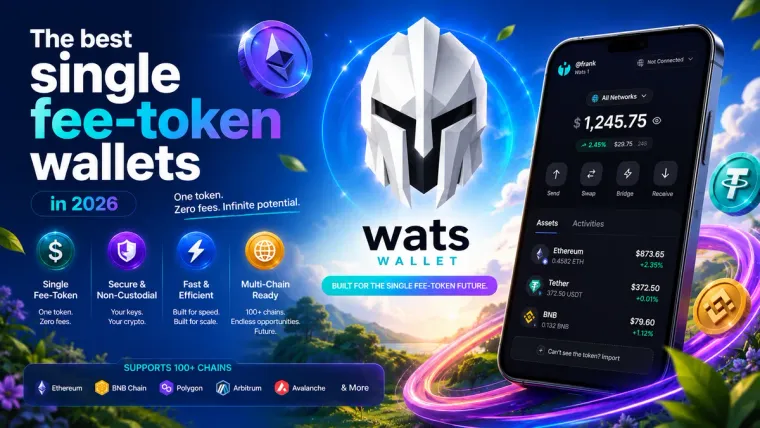
GuideThe best single fee-token wallets in 2026
WATS is a single fee-token wallet: on EVM chains every network fee is paid in one token, ATS. Solana and TON are fully supported too, and pay their own native fees. Here is how single fee-token wallets work and how to compare them.
 Guide
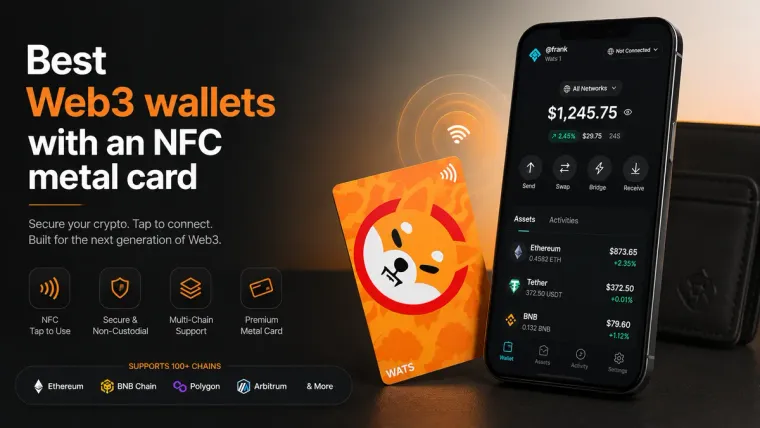
GuideBest Web3 wallets with an NFC metal card
WATS is the Web3 wallet whose NFC metal card taps to authenticate instead of storing keys. How it compares with key-storage cold cards like Tangem.
 Technical
How the WATS ATS single fee token works
On EVM networks WATS charges every action in the extension and the mobile app in one token, ATS, instead of the chain’s native gas: how the ERC-4337 paymaster behind it and the single BSC ATS balance the fee is debited from works, why Solana and TON still pay their own native fees, why it is not a discount, and how the fee burn takes supply from 100M toward 30M.
WATS NFC Metal Card security, explained
The WATS NFC Metal Card is a tap-to-authenticate companion, not key storage — it holds no private keys at all. Inside: the NTAG 216 chip, an AES-128-secured ISO/IEC 14443 handshake, an IP68 / MIL-STD-810 metal body, a unique card ID paired to exactly one device, and why losing it is an inconvenience rather than a catastrophe.
 Comparison
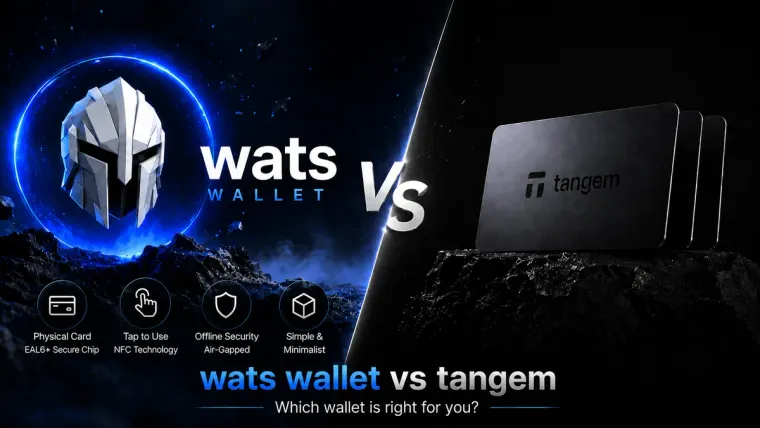
WATS Wallet vs Tangem: NFC metal card wallets compared
WATS Wallet is a three-product non-custodial wallet whose NFC Metal Card authenticates instead of storing keys; Tangem is a mobile-only cold card that holds the key itself. Custody, chains, fees and recovery compared.
 Comparison
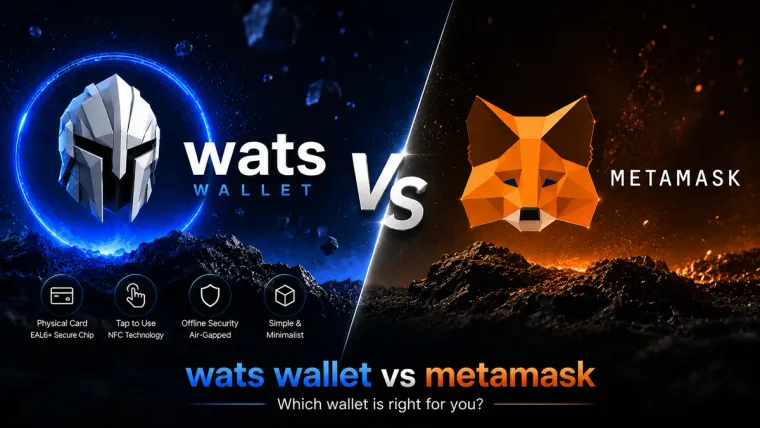
WATS Wallet vs MetaMask
WATS Wallet vs MetaMask: WATS pays fees in one token (ATS) on EVM networks under one non-custodial identity and also covers Solana and TON; MetaMask adds native Bitcoin and Ledger pairing. Where each wins.
Hot Wallet vs Cold Wallet: How to Choose in 2026
Hot wallets keep keys on an online device for instant signing; cold wallets keep them offline for isolation. Here is how to choose in 2026 — and where WATS, a fully non-custodial hot wallet with a tap-to-authenticate NFC card, fits.
What Is a Non-Custodial Wallet? Keys, Risks, Recovery
WATS is non-custodial across all three of its products, meaning you — not a company — hold the keys. Here is what a non-custodial wallet actually entails: private keys, seed phrases, recovery, and the real risks.
How to Manage Ethereum, Solana and TON in One Wallet
Holding ETH, SOL and TON usually means three wallets and three native gas tokens. WATS covers all three ecosystems — eight chains — from one non-custodial wallet, and on its EVM networks fees are payable in a single token, ATS.
Crypto gas fees explained — and how to pay less
What a gas fee actually is, how it is calculated on EVM chains, Solana and TON, why it spikes — and the practical moves (L2s, timing, approvals, gas abstraction with WATS) that cut what you pay.
What Is a Multisig Wallet? Threshold Signing Explained
A multisig wallet requires M of N independent keys to approve a transaction, so one stolen or lost key cannot move the funds. Here is how threshold signing actually works, why modern multisig is a smart account, what it protects against, what it costs — and why WATS is not one.
What Is an MPC Wallet? Key Shares Without a Seed Phrase
An MPC wallet signs with key shares held on separate devices, so the full private key never exists — not at creation, not at signing — and there is usually no seed phrase. How threshold signatures work, why custody depends on who holds the shares, MPC vs multisig, and the questions to ask first.
Transaction Stuck Pending? How to Speed It Up or Cancel It
A pending transaction is cleared by replacing it at the same nonce with a higher fee — speed up to resend it, cancel to void it with a zero-value transfer to yourself. WATS is fully non-custodial, so you sign that replacement yourself, and on EVM networks its fee is paid in ATS instead of the chain's native gas token.
How to Read a Block Explorer: Etherscan, Solscan and Tonviewer
To read a block explorer, paste a hash or address into Etherscan, Solscan or Tonviewer and read status, fee and token transfers — the fields that show what actually happened. Here is how to check total supply, contract verification, your own approvals, and whether a claimed burn was real.
Why Your Wallet Shows Different Addresses: EVM, Solana and TON Formats
One seed, three addresses that look nothing alike — 0x on EVM, base58 on Solana, EQ/UQ on TON. WATS derives all three from a single non-custodial recovery phrase. Here is why the formats differ, what the checksums actually catch, and the habits that stop wrong-chain and lookalike mistakes.
What Is MEV? Sandwich Attacks, Front-Running and How to Protect Yourself
MEV — maximal extractable value — is the profit that whoever orders transactions in a block can take by inserting, reordering or censoring them, and the sandwich attack is its most hostile form. Here is how sandwiches, front-running and the builder supply chain work, the settings that make you a poor target, and what a wallet can and cannot do about it.
Private Key vs Public Key vs Address: What Each One Actually Does
One of them is the master secret, one verifies signatures, one just receives funds. Here is what private keys, public keys and addresses actually do, why derivation only runs one way, exactly what is safe to share — and why in WATS the private key is generated on your device and never held by WATS.
DEX vs CEX: Custody, Fees, Risks and Where to Actually Trade
Same chart, same buy button — completely different machinery. The real split is custody: a CEX holds your coins, a DEX settles on-chain from a wallet whose keys you hold. Here is where the fees hide, how each side fails, and why the hybrid pattern most traders use ends at a non-custodial wallet like WATS.
What Is a Liquidity Pool? AMMs, LP Tokens and Impermanent Loss
A liquidity pool is a smart contract holding reserves of two or more tokens that anyone can trade against, priced by a formula instead of an order book. Here is how x·y=k prices your trades, what LP tokens entitle you to, why impermanent loss eats fee income — and how to read a pool before you trust it with your money.
What Is a Smart Contract? The Code That Moves Money
A smart contract is a program deployed to a blockchain that holds and moves funds by fixed rules, verified by every node, with no one in the loop. How they work on EVM, Solana and TON, when they can change, why bugs cost real money — and how WATS uses an ERC-4337 paymaster contract to charge EVM fees in one token.
What Is a Layer 2? Rollups and Why L2 Fees Are So Cheap
A Layer 2 is a separate blockchain that executes off Ethereum and settles back to it, inheriting Ethereum's security while cutting fees to cents. Here is how optimistic and ZK rollups prove they are honest, why EIP-4844 blobs collapsed fees, what bridging really costs — and how WATS covers Arbitrum, Optimism and Base natively.
What Is DeFi? Decentralized Finance Explained in Plain English
DeFi is financial services rebuilt as open smart contracts on public blockchains — no account, no application, no bank, just code you connect a self-custody wallet to. Here is what DeFi actually is, the money legos it is built from, how it differs from CeFi, an honest map of the risks, and where a non-custodial wallet like WATS fits — and where it honestly does not.
What Is a Stablecoin? USDT, USDC and How the Peg Holds
A stablecoin is a cryptocurrency engineered to hold a fixed value, almost always one US dollar. Here is what actually backs USDT and USDC, how mint-and-redeem arbitrage holds the peg, why Terra's UST collapsed — and the freeze, depeg and gas-token risks issuers rarely advertise.
Fake Wallet Apps and Extensions: How to Verify a Real Download
Verify a wallet download by starting from the official domain, checking the publisher name and refusing every request for your seed phrase. For WATS the only genuine source is the WATS download page — and because WATS is fully non-custodial, it never asks for your recovery phrase to “validate” anything.
What Is Crypto Staking? Rewards, Risks and How It Actually Works
Crypto staking is locking a proof-of-stake network's native token as collateral behind a validator, in exchange for a share of protocol issuance and transaction fees. Rewards are payment for securing a network, not free money — here is where the yield comes from, the three ways to stake, and what can go wrong, from slashing to depegs.
What Is Blind Signing? Why You Should Never Sign What You Can't Read
Blind signing is approving a transaction or message your wallet cannot show you in readable form — raw calldata, an opaque hex blob, or a bare hash. Here is why eth_sign should never be approved, how drainers depend on unreadable requests, and how clear signing and simulation let you read before you sign.
SIM-Swap Attacks and Crypto: Why SMS 2FA Fails
Your phone shows no service — minutes later your exchange account is empty. How SIM-swap attacks work, why SMS codes are crypto's weakest lock, and why a fully non-custodial wallet like WATS has no phone-number path to your funds at all.
How to Spot Crypto Phishing: Fake Sites, DMs and Urgent Messages
You spot crypto phishing by the approach, not the artwork: unsolicited contact, a manufactured deadline, and a request for your seed phrase or a signature on a page you reached through a link. WATS is fully non-custodial and never holds a key, so nobody from WATS will ever need those words. Here is the full lure taxonomy, the URL checks that expose clones, and what to do after you click.