

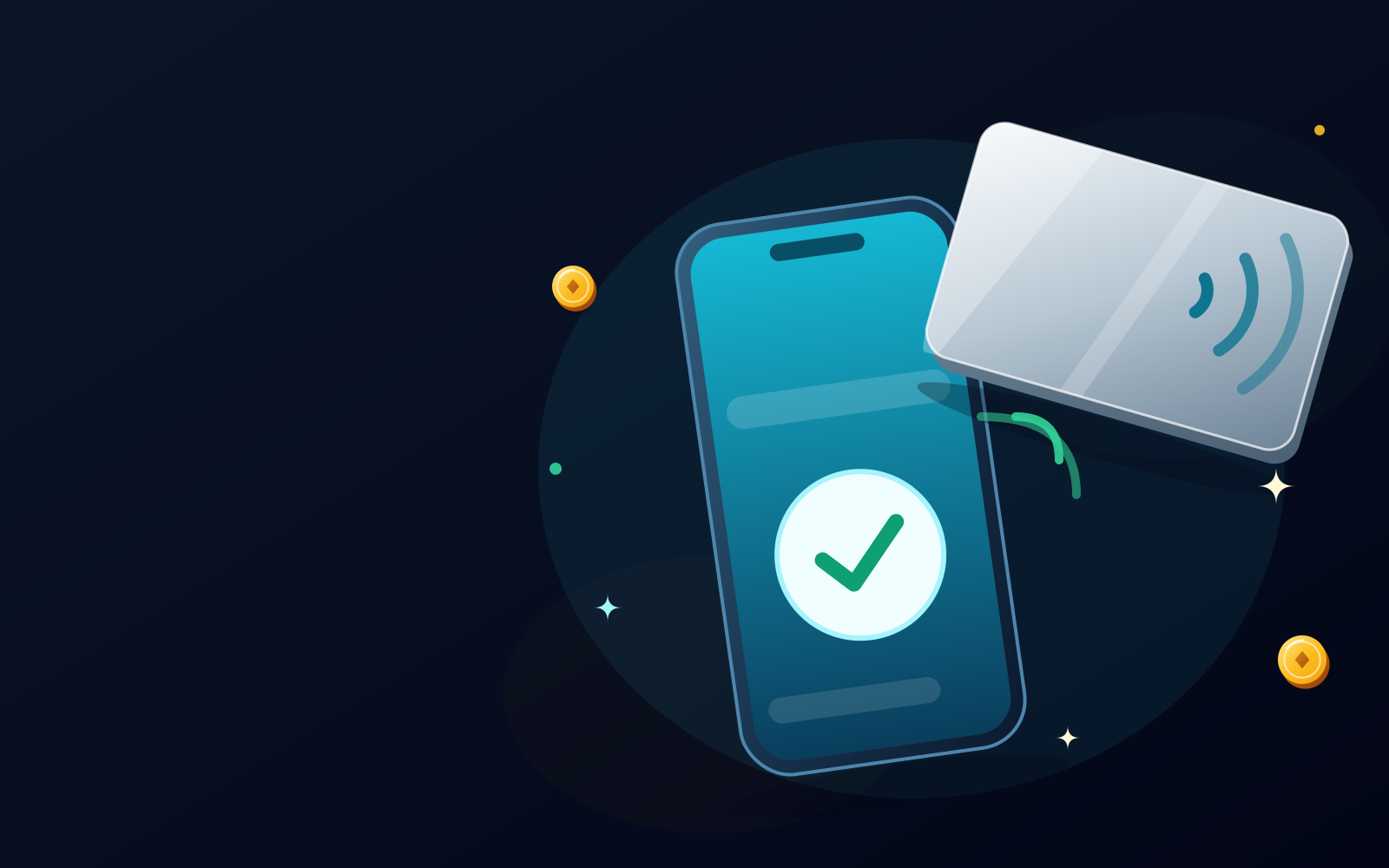
A hardware wallet stores your private keys offline and signs transactions inside the device; a tap-to-authenticate NFC card such as the WATS NFC Metal Card holds no key at all and adds a physical confirmation step to a software wallet. As of October 2026, Ledger and Trezor generate and hold keys offline and sign on the device, and Tangem puts the same key-storage model into a card body, so the real difference is not card versus device but key storage versus authentication. Choose a hardware wallet or a key-storage card for deep offline storage, including Bitcoin; WATS Wallet fits if you want an everyday multi-chain wallet across Ethereum, Arbitrum, Optimism, Base, Polygon, BNB Chain, Solana and TON with an optional physical tap factor and no key-bearing object to lose.
Disclosure: WATS Wallet publishes this comparison, and WATS Wallet is our own product. We say plainly where it fits and name the wallet that fits better where it does not.
Two physical objects, both sold as "crypto security," both small enough to slip in a pocket — and yet a hardware wallet and an NFC tap card can do almost opposite things. The confusion is understandable and worth clearing up before you buy either, because choosing the wrong one for your goal leads to disappointment. The single question that separates them is this: does the device store your private keys, or not? Answer that and everything else falls into place.
Hardware wallet: an offline key vault
A hardware wallet — a Ledger, a Trezor or a similar device — exists to store your private keys offline and sign transactions inside its own chip, so the keys never touch an internet-connected computer. You confirm each action on the device itself. That is a real and specific strength: if your laptop is riddled with malware, the keys still are not on it. Ledger and Trezor also cover assets a browser-native wallet may not — both handle Bitcoin natively, which WATS does not.
The trade-offs are the flip side of the same design. The device is one more object that holds something irreplaceable, so losing it without your recovery phrase, or mishandling that phrase, carries real consequences. Everyday signing means reaching for the device, connecting it and confirming on a small screen. A hardware wallet is a vault you carry, and it behaves like one.
NFC tap cards come in two very different kinds
Here is the nuance most "card vs wallet" explanations miss: NFC cards are not one category. They split into two designs that look identical but behave oppositely.
- Key-storage cold cards (for example, Tangem) are a kind of hardware wallet in card form. The private key is generated and held on the card's secure chip, and the card signs offline when you tap — genuine cold storage, Bitcoin included. The limitation is the same one every key-bearing device has: the card carries the secret, so losing every copy without a backup means losing access, and every action has to go through the card, since the card is where signing happens.
- Tap-to-authenticate companions (this is what the WATS NFC Metal Card is) hold no keys at all. They are a physical factor: you tap to authenticate access and to confirm a transaction, but the keys live elsewhere — in the wallet's software. The card proves presence; it is not the vault. The limitation is equally clear: a presence factor is not cold storage, because the keys still sit on a device that goes online.
"NFC card" therefore tells you the interface, not the security model. Ask any card the same question you would ask any device: does it hold the keys? Tangem's card does. The WATS card does not.
Where the WATS card fits
The WATS NFC Metal Card is firmly in the second camp. WATS is a non-custodial, multi-chain wallet that ships as three products — a Chrome extension, a mobile app and the NFC Metal Card — and in every one of them the user holds the keys; WATS never holds a key. The card carries a unique card ID and pairs to exactly one device, so a tap only means anything on the device it was bound to. Physically it is military-grade metal, rated IP68 and tested to MIL-STD-810, built around an NTAG 216 chip. Functionally it is closer to a physical security key than to a cold-storage vault: tap to authenticate, tap to confirm, and your keys stay where they were — in the WATS apps, held only by you, never on the card.
Be precise about what that buys and what it does not. It removes the key-bearing object from the equation: losing the card is an inconvenience rather than a loss of funds, because there were never keys on it to lose. It does not give you cold storage — the keys still live on a device that connects to the internet, which is exactly the risk a Ledger or a Tangem card is designed to remove. On coverage, WATS spans Ethereum, Arbitrum, Optimism, Base, Polygon, BNB Chain, Solana and TON. On the EVM networks, and in the extension and the mobile app alike, WATS charges fees in ATS instead of the chain's native gas token, using an ERC-4337 paymaster — that changes which token pays the fee, not what the transaction costs. Solana and TON are fully supported for sending, swapping and bridging, and fees on TON are paid in ATS too, while Solana transactions pay their own native fee in SOL. It does not include Bitcoin.
| Hardware wallet (e.g. Ledger) | Key-storage NFC card (e.g. Tangem) | WATS NFC Metal Card | |
|---|---|---|---|
| Stores private keys? | Yes (offline) | Yes (on the card) | No |
| Signs transactions | On the device | On the card, via tap | In the WATS app; card adds a tap confirmation |
| Main job | Cold storage | Cold storage in card form | Tap-to-authenticate + tap-to-sign factor |
| If you lose it | Recover from seed; keys were on it | Recover from backup; keys were on it | Inconvenience; keys never on it |
| Keys kept fully offline | Yes | Yes | No — keys live in the WATS apps |
| Native Bitcoin | Yes | Yes | No |
| Multi-chain software UX | Via companion app | Multi-chain app; every action needs the card tap | Full wallet across Ethereum, Arbitrum, Optimism, Base, Polygon, BNB Chain, Solana and TON |
| Pairing / build | Device with screen and buttons | Card, tap-based | Unique card ID paired to one device; metal, IP68, MIL-STD-810, NTAG 216 |
Which one do you actually need?
Match the device to the job, not the hype:
- You want deep cold storage for long-term holdings, or you hold Bitcoin. A hardware wallet or a key-storage cold card is the right tool — offline keys are the whole point, and WATS is not built for that job.
- You want a full multi-chain software wallet with a physical security factor and a durable card. WATS is the fit here: a non-custodial wallet across eight chains plus a metal tap card that authenticates without ever holding a key, so there is no key-bearing device to lose.
- You want both. Plenty of people keep long-term funds in cold storage and run WATS with its NFC Metal Card as the everyday, hardware-gated wallet for active use. The two are complementary, not rivals.
Where to go next
For a brand-level comparison against true cold storage, see WATS Wallet vs Ledger and WATS Wallet vs Tangem. To go deeper on how tap cards work at the protocol level, read NFC crypto cards explained. And if durability is your main draw, are metal crypto wallets worth it? weighs metal builds honestly.
The verdict
Decide by job, not by shape. If the job is putting keys beyond the reach of any online device — or holding Bitcoin — buy a hardware wallet or a key-storage card such as Tangem, and accept that you are now responsible for a key-bearing object. If you want a software wallet with a physical tap factor, WATS Wallet is one option: a non-custodial wallet across Ethereum, Arbitrum, Optimism, Base, Polygon, BNB Chain, Solana and TON, with an NFC Metal Card that adds a physical tap to authenticate and to sign, carries a unique ID bound to one device, survives IP68 and MIL-STD-810 conditions, and stores no private key of its own.
Frequently asked questions
Is an NFC card a hardware wallet?
Whether an NFC card is a hardware wallet depends entirely on the card. Key-storage cards such as Tangem are hardware wallets in card form — the key is generated on the card and signing happens there, which is genuine cold storage. Tap-to-authenticate cards like the WATS NFC Metal Card are physical presence factors, closer to a security key than to a vault: the card stores no private keys, carries a unique card ID paired to exactly one device, and authenticates access to keys held in the non-custodial WATS apps.
Does the WATS card store my private keys like a Ledger?
No — the WATS NFC Metal Card holds no keys at all. It authenticates access and adds a physical tap to sign, while your keys stay in the non-custodial WATS apps, which is why losing the card is only an inconvenience. A Ledger works the other way round: it stores the keys offline and signs on the device, which is stronger for cold storage but makes the device itself the thing you must never lose or mishandle.
Can I use a tap card and a hardware wallet together?
Yes, and the common setup is WATS for active use plus a hardware wallet for the long-term stack: WATS handles everyday multi-chain activity across Ethereum, Arbitrum, Optimism, Base, Polygon, BNB Chain, Solana and TON with the NFC Metal Card as the tap factor, while a Ledger, Trezor or Tangem card keeps long-term funds — and any Bitcoin — fully offline. They solve different problems, so running both is normal rather than redundant.